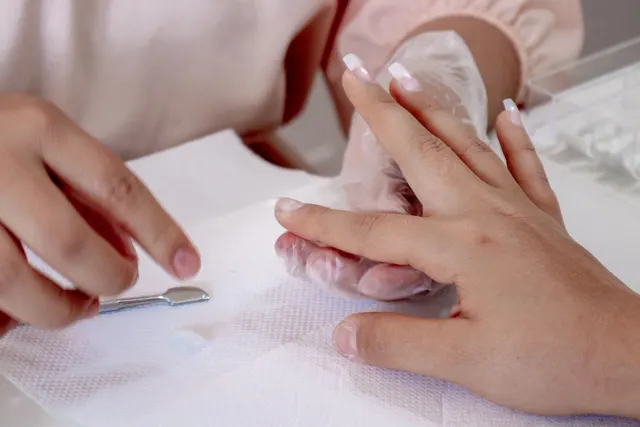
The colour is usually the enjoyable decision. A glossy burgundy, a pale pink, something bright enough to interrupt an ordinary week. Less visible is the decision happening around the edges of the nail: which product is being used, where it touches, and how it is cured.
That is where a useful conversation about gel manicures begins. Not with the assumption that everyone who enjoys them will develop an allergy, and not with the reassurance that a tidy finish proves there is nothing to consider. The material before curing matters as much as the appearance afterwards.
This is adult consumer education about nail-product allergy, not a diagnosis or a guide to applying, testing or treating gel products at home. It does not describe a Diva service or a client’s experience. Its purpose is to make a familiar beauty choice easier to understand, including when the sensible choice is to pause.
The problem is not simply the word gel
Gel polish and other artificial nail systems can contain chemicals from the acrylate and methacrylate families. These ingredients help create the coating, but exposure to their uncured forms can sensitise the skin. Sensitisation means developing an allergy, not merely deciding that a product feels unpleasant.
The British Association of Dermatologists warns that uncured product touching skin, and insufficient curing, can increase allergy risk. Its advice applies to the possibility of reactions both at home and in salons. The association specifically cautions against mixing separately purchased polishes with an inappropriate lamp. British Association of Dermatologists: artificial nail warning
For a consumer, this changes the useful question. Rather than asking only whether a bottle is a good brand, ask whether the product and its application system are being used as intended. A brand name cannot substitute for that explanation.
Nor does the word professional describe the condition of every individual application. Training and competent practice matter, but a salon setting is not a guarantee that allergy is impossible. The aim is to reduce avoidable exposure, not to buy a promise that nobody can make.
A clean-looking edge is more than a style preference
A small amount of uncured gel on the surrounding skin is easy to think of as a cosmetic mistake that can be tidied later. In an allergy discussion, it is an exposure worth preventing.
The useful boundary is between the nail and the skin around it. That includes the nail folds and cuticle area, not just a large spill on the hand. A consumer should not feel awkward about drawing attention to product touching skin or asking the technician to pause and address it appropriately before proceeding.
This is not an invitation to correct the application yourself. Do not smear the product with a fingertip or improvise a cleaning method. The point of raising the issue is to interrupt an avoidable exposure and let a competent professional follow the product’s instructions.
The UK’s cosmetic-industry association, CTPA, advises keeping these systems off skin and applying them only to healthy nails. Its guidance also says not to apply to cracked, split or bruised nails, or where the surrounding skin is sore, inflamed or broken. This is industry guidance, not a South African regulatory ruling or an assurance about a particular salon. CTPA artificial-nail allergy guideline, September 2023
A special occasion does not make irritated skin a better surface for a cosmetic procedure. Postponing can be a complete decision, not a failed appointment.
The lamp is part of the product system
Curing is not simply waiting until a coating looks dry. It is part of the chemical process that produces the finished material. That makes compatibility between the product and the recommended lamp important.
CTPA’s guidance says it is not possible to establish a complete cure just by looking at the nail. It recommends following the manufacturer’s instructions for the appropriate lamp and curing time. CTPA guidance on correct lamp use
From the customer’s chair, that means an attractive surface is not a useful test of what happened within the coating. Neither is a confident claim that any lamp works with any polish.
You do not need to inspect circuitry or calculate exposure times. A reasonable question is whether the lamp is the one recommended for the system being applied. The answer should connect the equipment to the product instructions, rather than rely on an improvised extra interval under the light.
This article deliberately supplies no universal curing time. Different products have different requirements. Turning a general safety discussion into a single timing rule would remove the very information that makes the decision meaningful.
If you cannot establish what the product is or how it should be used, uncertainty is a reason to stop and clarify, not a reason to experiment on your hands.
HEMA-free is not the same as allergy-free
HEMA is the abbreviation for one methacrylate ingredient often discussed in nail-allergy reporting. A label saying it is absent does not, by itself, tell you that every other ingredient is suitable for you.
An original Portuguese study published in 2017 reviewed records from thirteen dermatology departments. It identified 230 cases of nail-product-related allergic contact dermatitis among consumers, technicians and people with both kinds of exposure. HEMA was a frequent positive allergen, but the researchers also identified others. Raposo and colleagues: five-year study
That supports a narrow but important conclusion: this is not a story about only one ingredient. It does not tell us the chance that a randomly selected South African manicure customer will develop an allergy. The study reviewed people already identified with relevant dermatitis; it was not a population survey or a comparison trial of current HEMA-free products.
The practical interpretation is to read an exclusion claim literally. It tells you something about one ingredient, not everything about a formulation. The same restraint applies to reassuring words such as gentle or sensitive.
If you have a suspected or confirmed allergy, swapping to a different bottle on the strength of a front-label claim is not a substitute for individual advice. The question is what you react to and which exposures need avoiding, not which phrase sounds most reassuring.
Why the rash may not be beside the manicure
A nail-product reaction does not always announce itself in the place a person expects. Eczema UK describes nail changes, splitting fingertips and inflammation around the nails, as well as symptoms on areas commonly touched, including the eyelids, mouth and neck. Eczema UK: nail allergy and eczema
That possibility is useful information for a clinical history, not a way to diagnose every eyelid rash as a manicure allergy. Many problems can look similar, and a new symptom may have another explanation.
If a rash develops, mention recent nail treatments when speaking with a clinician even if the hands seem less affected than the face. The connection might otherwise be easy to leave out because the appointment concerned a different part of the body.
A short timeline can help: when the manicure happened, when symptoms appeared, where they started and whether a similar pattern occurred previously. Keep product names or photographs of packaging if available. Describe what happened without deciding in advance which ingredient caused it.
There is a difference between noticing a possible association and establishing a diagnosis. The first can help you ask a better question. The second needs an appropriate assessment.
Irritation and allergy are not interchangeable
Contact dermatitis can result from direct irritation or from an allergic response. The NHS distinguishes an irritant that damages the skin’s outer layer from an allergen that prompts an immune response. It also notes that inflamed skin can look dark brown, purple or grey on darker skin, rather than displaying the redness often used in descriptions. NHS: contact dermatitis overview
This matters because a photograph and a few symptom words cannot reliably separate every cause. Dryness after removal, a painful nail and an itchy rash should not all be filed under one assumed explanation.
Nor should the absence of a previous reaction be treated as permanent clearance. The relevant question is what is happening now, considered alongside exposure history. “I have always used this” is useful background, but not a reason to dismiss new symptoms.
Avoid trying to settle the question by reapplying the suspected product. Another exposure is not a consumer experiment with a harmless result. Waiting for a more dramatic reaction would not make the investigation better.
You can be clear without claiming certainty: “I developed these symptoms after this treatment, and I need advice before using it again.” That is enough to start the right conversation.
A home patch test is not the answer
The phrase patch test can sound like something easily improvised with a dab of product. For acrylates, that is the wrong approach.
DermNet states that acrylate monomers should not be applied directly to skin as an informal test because doing so risks causing sensitisation. Clinical patch testing uses an appropriate specialist process to investigate contact allergy. DermNet: allergy to acrylates
Do not put uncured gel behind your ear, on your arm or on another small patch of skin to check whether you can tolerate it. A smaller area is still skin exposure. An uneventful trial would not provide a reliable guarantee about later use either.
If a clinician recommends patch testing, ask what the results mean for your actual products and future choices. A list of positive names is more useful when accompanied by an explanation of what to avoid and how to recognise relevant ingredients.
There is no need to arrive with a self-selected testing protocol. Bring the history and product information you have, and let the assessing professional decide which investigation is appropriate.
When to seek help rather than another appointment
If you suspect a reaction, stop further use of the suspected nail product and seek advice about assessment and appropriate removal. Do not book a replacement set to cover changes, and do not pick or tear off the coating. The American Academy of Dermatology advises against picking gel polish; removal should be approached appropriately rather than treated as an emergency home scraping exercise. AAD: gel manicures and nail health
Persistent, recurrent or severe dermatitis warrants medical assessment. Do not wait for a routine beauty appointment if symptoms are substantial or worsening. NHS: when to seek medical advice
Seek urgent medical advice for rapidly worsening symptoms, increasing pain, discharge, or feeling unwell, hot or shivery. These can be signs of infection and need prompt assessment. NHS: contact dermatitis symptoms
Difficulty breathing, sudden swelling of the mouth, tongue or throat, or fainting requires emergency help immediately. This is an emergency distinction, not a suggestion that every itchy nail fold is anaphylaxis. Use the emergency services where you are; the linked NHS page gives UK-specific contact instructions. NHS: anaphylaxis warning signs
This article does not prescribe creams, medication or a removal regimen for an inflamed hand. The right response depends on the problem, not just on the fact that a manicure preceded it.
The implications can extend beyond a bottle of polish
A confirmed acrylate allergy is information worth keeping in your medical record. The British Association of Dermatologists notes that related substances can occur in dental materials, medical adhesives and other healthcare products. BAD: wider implications of sensitisation
That does not mean someone with a nail-product allergy can never receive a filling, a medical device or an operation. It means the exact allergy should be discussed with the treating clinician or dentist so suitable materials and plans can be considered.
Do not remove an existing medical device or delay necessary care because of a general beauty article. Share the diagnosis and any written testing results with the relevant professional.
This is one reason a vague personal label such as “allergic to nails” is less useful than a properly investigated result. A brand name can change; a clinician needs to know which substance or substances are relevant.
The objective is informed care, not a frightening list of things to avoid without guidance. A clear record can help future conversations stay specific.
Choose an alternative without making it another experiment
It is reasonable to decide that gel is not worth the uncertainty for you. It is also reasonable to enjoy a simpler finish, traditional polish or uncoated nails without presenting that choice as a moral achievement.
The AAD suggests considering traditional polish instead of gel, particularly with recurring nail problems. That is general nail-care advice, not a guarantee that every conventional polish is appropriate for every diagnosed allergy. AAD guidance
A change of category can introduce different ingredients rather than no ingredients of concern. If you already have symptoms or a diagnosis, discuss alternatives rather than choosing by phrases such as clean, natural or hypoallergenic alone.
The same principle applies to taking a break. Time without a manicure can create space for assessment, but a calendar interval does not certify that re-exposure to an allergen is safe. Do not treat a holiday from gel as an informal reset button.
Sometimes the best next purchase is no purchase. You can wait until you understand the reaction rather than trying to maintain the original look while the explanation remains unresolved.
Questions worth taking to a nail appointment
Before application, ask which product system will be used and whether the lamp is recommended for it. Mention previous nail-product reactions, current nail changes and inflamed or broken surrounding skin. If you have a diagnosed allergy, bring the relevant information rather than relying on a shorthand label.
Ask what happens if product touches the skin, and who you should contact if symptoms develop later. These are practical questions about the procedure, not demands for a promise that no reaction can occur.
You are also allowed to change your mind. Choosing a colour, arriving on time or having paid a deposit does not oblige you to ignore a health concern. Booking terms and health decisions are different conversations.
A useful answer explains the process and its limits. It does not dismiss concerns because many other customers have been fine, and it does not turn a product’s marketing claim into personal medical clearance.
Quick questions about gel manicures
Does a lamp labelled LED automatically make a gel system suitable?
No. The useful question is whether the manufacturer recommends that lamp for the product being applied. The general equipment label does not tell you whether this particular combination will cure the coating as intended.
Can I ask the salon for information after a reaction?
Yes. Ask for the product names and, where available, photos of the labels or ingredient lists. Keep those details for the clinician assessing the reaction. There is no need to handle an uncured sample or have another set applied to find out what was used.
What if I want the look but would rather not use gel?
An ordinary polish or uncoated nails are reasonable options if there is no active concern. If a recent reaction has not been assessed, wait for advice before trying another product. “Not gel” and “suitable for my allergy” are different claims.
A finish you choose with more information
Gel manicures are often discussed through their finished appearance: shine, shape, colour and wear. Allergy prevention asks us to look earlier, at uncured material, skin contact and the system used to cure it.
The aim is not to make every appointment feel alarming. It is to recognise which details deserve an explanation, which labels cannot guarantee suitability and which symptoms belong with a healthcare professional rather than another coat of colour.
The manicure decision starts before the lamp. It can end with a chosen shade, a different option or a decision to wait. All three can be informed choices.