The lunch is ready before the working day begins: last night’s cooked chicken, a little salad, perhaps a yoghurt for later. The container closes properly. Nothing leaks. It looks like a small victory over a busy morning.
But the container is not the whole plan. Between the kitchen and lunchtime there may be a commute, an appointment, a warm vehicle and a meeting that runs late. A meal prepared with care can spend much longer away from refrigeration than its owner intended.
This is a hypothetical workday, not a Diva client story. It captures a question worth asking before South Africa’s warmer days turn a packed lunch into a guessing game: where will the food be kept cold until you eat it?
The answer might be a workplace fridge, a properly packed cool bag or a different lunch that does not require refrigeration before opening. None is a moral victory over the others. The useful choice is the one that fits your actual day, including the possibility that lunch will be delayed.
Start with the journey, not the recipe
Meal preparation advice often ends when the lids go on. Food safety continues through storage, transport, waiting and serving. Before choosing tomorrow’s lunch, sketch those stages in ordinary language: fridge at home, transport, destination, eating time.
Where is the weak link? A short drive to a workplace with a functioning fridge is a different problem from several hours moving between sites. A shared fridge that is always full creates a different problem again. An insulated bag left at home cannot help the food in your handbag.
The World Health Organization’s Five Keys to Safer Food links cleanliness, separation of raw and cooked foods, thorough cooking, safe temperatures and safe water. Temperature control is one part of that chain, not a substitute for the others.
Try asking about tomorrow rather than about an ideal routine. Will you actually reach a fridge? Can you keep a cooler with you? Do you have a clean place to eat? Will you have water for washing your hands? These questions may change the menu, but they also prevent you from packing food for facilities you do not have.
What “keep cold” means
The South African Department of Health’s food-safety poster advises prompt refrigeration of cooked and perishable food, preferably below 5°C, and keeping cooked food above 60°C before serving if it is being held hot. It also says not to leave cooked food at room temperature for more than two hours.
Those are practical handling boundaries, not permission to aim for the limit. Food does not suddenly switch from safe to unsafe at a magic minute, and you cannot reconstruct its whole temperature history by touching the outside of a container.
For the cold-lunch examples here, the working goal is to keep food chilled, preferably below 5°C, from storage through transport and waiting. A fridge thermometer helps establish whether the fridge is doing its job. A bag described as insulated does not establish that its contents have stayed at a suitable temperature.
This distinction matters when work changes unexpectedly. If a meeting moves from an office to another location, the lunch may need a new plan too. The important detail is not whether you packed it at home. It is what happened after you took it out of the fridge.
Three workdays, three different plans
Consider three imaginary adults. Their circumstances, not their willpower, determine the sensible approach.
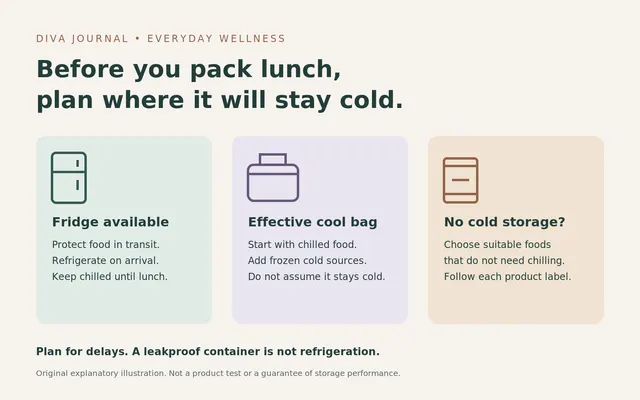
The office worker has reliable refrigeration. Their main task is to protect the chilled meal during the journey and put it in the fridge on arrival rather than leaving it under the desk until noon. A reminder attached to the morning routine can be more useful than another complicated recipe: keys away, lunch into the fridge, then start work.
The mobile worker has no dependable fridge. Their lunch must travel with effective cold storage for the time involved, or be chosen differently. “I will probably find a fridge” is not a plan if the first appointment can change. A meal that depends on refrigeration is a poor fit for a day when nobody knows where it will be kept.
The worker without a cold source chooses shelf-stable components. Depending on the product and its label, unopened commercially shelf-stable foods can offer another route. Whole fruit, bread or crackers and suitable unopened shelf-stable accompaniments are possible components, subject to allergies and storage instructions. A packet that needs refrigeration once opened should stay sealed until it is used; its leftovers do not inherit the unopened product’s shelf stability.
These are planning examples, not nutritionally complete menus. Their purpose is to show that a safe arrangement begins with available facilities. You can build variety and enjoyment around that arrangement rather than hoping an attractive recipe will solve the storage problem.
The CDC’s travel food guidance identifies factory-sealed foods, such as canned tuna and packaged crackers, as generally safer choices when unopened and properly handled. This is US travel guidance, not a claim that every sealed product can tolerate any storage temperature.
A cool bag needs something cold inside it
An insulated bag slows heat transfer. It is not a miniature refrigerator with its own cooling system. Packing chilled food with frozen cold sources is different from putting a lukewarm lunch into an empty insulated bag and expecting it to cool down.
The UK Food Standards Agency’s picnic guidance recommends ice or frozen gel packs, distributed through a cool box or bag rather than all placed at the bottom. It also recommends keeping openings to a minimum. Food usually refrigerated at home still needs cold storage when taken elsewhere, including cooked dishes, dairy, prepared sandwiches and cut fruit.
For a working day, translate that into a packing routine: start with chilled food, put it into suitable insulated storage with frozen cold sources, close the bag and keep it away from direct sun. Do not use the space around a lunchbox for items that force the bag to remain partly open. Keep your lunch separate from things that may contaminate its eating surfaces.
An August 2025 USDA lunch-packing bulletin recommends at least two cold sources, positioned around perishable items in an insulated lunchbox. This US recommendation is a useful starting point, not a guarantee for every journey.
The number and size of cold sources needed depend on the bag, food, conditions and duration. There is no honest universal promise that a particular bag will protect every lunch until a particular hour. Follow the manufacturer’s instructions and check performance in the conditions where you will actually use it.
If the plan cannot reliably keep the food cold, change the food or arrange another source of lunch. Buying a safe alternative is preferable to deciding that a questionable meal must be eaten because you spent time preparing it.
What lunchbox research can, and cannot, tell us
A small piece of research illustrates why equipment alone is not proof. A 2011 study in Pediatrics assessed 705 packed lunches from 235 children attending nine childcare centres in central Texas. Researchers measured food temperatures about an hour and a half before lunch.
Only 22 of 1,361 perishable items were within the study’s acceptable temperature range. Many lunches had ice packs, yet most measured items were outside that range. The study’s threshold for cold food was below 4°C, not the South African poster’s preferred below-5°C wording.
These findings do not measure today’s South African adult lunch habits. They do not establish how many children became ill, and temperature readings alone are not laboratory evidence that every item contained a dangerous pathogen. The study is old, local and observational.
Its useful lesson is narrower: the presence of an ice pack or a lunch bag does not prove a particular food remained cold. That is a reason to examine how a system works, not a reason to abandon packed lunches or assume that all cool bags fail.
Do not give a delayed lunch a fresh clock
Suppose a meeting runs late and you put your lunch back into a fridge after it has spent a long time warm. Refrigeration does not erase that earlier period. Nor does moving food from a desk to a shaded chair start its history again.
Think about the journey as a whole. Time spent packing, travelling and waiting matters when food is not being kept at a safe temperature. If you cannot establish that a perishable lunch stayed safely chilled, do not assume a few minutes back in the fridge restores it.
US Department of Agriculture guidance adds a useful hot-weather caution: perishables should not remain out for more than one hour when the surrounding temperature is above 90°F, approximately 32°C, rather than the usual two-hour limit. This is explicitly US consumer guidance, not a statement of South African law. It reinforces the point that a hot day leaves less room for casual waiting.
A backup can be simple. Keep a suitable unopened shelf-stable option available, know where you can obtain food safely, or plan a meal around the facilities at your destination. The backup does not need to resemble the lunch you originally imagined. It needs to remove the pressure to eat something whose storage has become uncertain.
Yesterday’s supper needs a plan before tomorrow morning
Leftovers make practical lunches, but transport cannot repair poor cooling the evening before. A large pot left on the counter overnight is not made safe by being placed in a cool bag the next morning.
The Food Standards Agency’s guidance on chilling describes cooling cooked food promptly and refrigerating it within one to two hours. For home organisation, smaller portions can make cooling and storage more manageable than one large container. Keep the preparation time in mind rather than waiting indefinitely for food to feel completely cold.
Rice needs particular attention. The FSA’s rice guidance explains that bacteria can multiply and produce toxins if cooked rice is left at room temperature. It advises rapid cooling, ideally within an hour, and keeping refrigerated rice for no more than one day before reheating. Reheat it only once, until steaming hot throughout.
The point is not that rice is an unsuitable lunch. It is that the safety story starts when it is cooked, not when it is packed. If you do not know when a leftover was prepared or how it was stored, do not invent a reassuring history for it.
Label a container with what it contains and when it was prepared. That small habit helps distinguish a deliberate lunch plan from a fridge full of indistinguishable leftovers. It also makes it easier to choose a portion without opening several containers and guessing.
Reheating is not a rescue service
A workplace microwave is useful for reheating food that has been safely prepared, cooled and stored. It is not a remedy for leaving a meal warm for hours.
The Food Standards Agency’s cooking guidance advises reheating leftovers only once, until steaming hot throughout. Microwaves can heat unevenly, so stirring or turning helps avoid cold areas. Follow the food’s instructions and allow any stated standing time.
This is another reason to pack the quantity you expect to use rather than repeatedly warming a large container and returning part of it to storage. If you are sharing a microwave, the fact that someone is waiting does not change the time your meal needs.
For people who prefer a hot lunch carried from home, safe hot holding is a separate approach. The South African poster’s above-60°C guidance applies; a flask that is merely warm at lunchtime is not evidence it achieved that. Use equipment designed for the purpose and its instructions. When you cannot maintain hot holding, choose an effective cold-storage and reheating arrangement instead.
Clean hands still belong in the story
Temperature receives much of the attention, but contamination can happen before a bag is zipped. Wash hands, use clean containers and keep ready-to-eat foods separate from raw meat and its utensils. The CDC’s food-poisoning prevention guidance organises these protections around cleaning, separating, cooking and chilling.
At work, give some thought to what your hands touched before lunch. A clean fork packed with the meal avoids having to improvise with shared equipment of uncertain cleanliness. Put the food on a clean surface, not on paperwork or equipment that has travelled through a dirty work area.
These suggestions are deliberately ordinary. Food safety should not require treating every lunch break like a laboratory. It does require noticing when the normal facilities are missing and bringing what is needed, including safe water where appropriate.
The sniff test cannot certify lunch
An unusual smell is a warning, but a normal smell is not a safety certificate. Do not taste a questionable meal to decide whether it is safe. CDC guidance explicitly warns against tasting food for this purpose.
If illness develops, do not assume the most recent meal must be responsible. The CDC’s symptom guidance notes that onset varies with the organism, from hours to days. Seek medical care for concerning symptoms such as bloody diarrhoea, persistent vomiting that prevents keeping fluids down, or signs of dehydration. Pregnancy, immune suppression and other medical circumstances may warrant earlier advice.
This article is about reducing risk, not diagnosing an illness or guaranteeing that careful handling eliminates every possibility of foodborne disease.
Questions before tomorrow’s lunch
Can I leave yoghurt beside my desk if the office feels cool?
Do not treat a comfortable room as refrigeration. Follow the product’s storage instructions and keep perishable food properly chilled until it is time to eat.
Is a vegetarian lunch automatically safe without a fridge?
No. Cooked foods, dairy, prepared salads and cut produce can still need chilled storage. Decide from the actual ingredients, preparation and storage instructions, not the absence of meat.
What if the meeting runs late?
Keep lunch in its effective cold storage until you are ready. If its safe storage has failed or become uncertain, use your backup rather than relying on smell or reheating.
What is the simplest useful change?
Before preparing the meal, decide where it will stay cold. A good container solves leaks. A good lunch plan also solves the hours between leaving home and finally sitting down to eat.
For the planning side of a working week, see why meal planning matters. Build the menu around the safe storage you actually have.