A bottle of sunscreen can spend most of its life waiting for a beach holiday. Then an ordinary Saturday arrives: breakfast outdoors, errands, a long conversation beside the braai. Nobody planned to sunbathe. By evening, the day has turned into a lesson in how easily outdoor time accumulates.
That is a hypothetical scene, not a Diva client story. It describes the question behind this article: how do you make sun protection work in the life you actually lead, rather than in an ideal routine you follow twice a year?
For South African adults heading into summer, the useful starting point is a combination of shade, clothing and correctly used sunscreen. The World Health Organization recommends protection when the UV Index reaches 3 or above. This is a guide to making those decisions, understanding the evidence and knowing when a skin concern needs professional assessment. It is general education, not a diagnosis or a personalised treatment plan. WHO ultraviolet radiation guidance
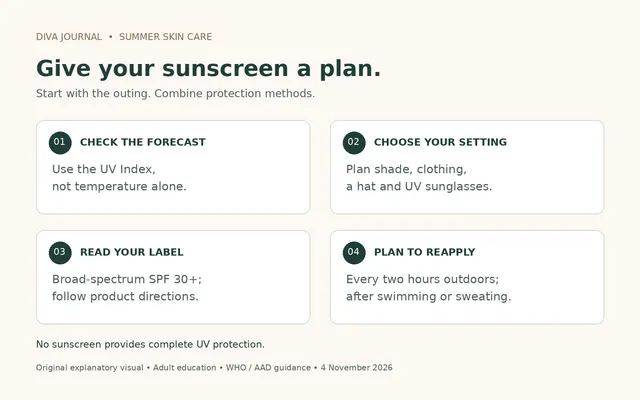
Start with the forecast you rarely look at
The temperature tells you how warm a day may feel. The UV Index describes the level of ultraviolet radiation and its potential to harm skin and eyes. It gives you another piece of information when choosing when to walk, where to sit or what to take with you. A higher value means greater potential harm and less time for it to occur. WHO UV Index explanation
Check the forecast for your location, rather than assuming that every South African town has the same conditions. Local conditions change through the day. WHO explains that altitude, season, time of day, cloud cover and reflection all influence exposure. A cool breeze or light cloud is not a dependable signal that protection is unnecessary. WHO ultraviolet radiation questions and answers
A useful personal planning question is: which part of this outing can I change? You may not be able to move an event, but you might choose a covered table, take a hat or arrange a shaded break. These are practical suggestions, not a promise that a particular timetable makes exposure safe.
Make shade and clothing part of the invitation
Sun protection is easier to organise before everyone settles into their seats. If you are hosting, think about where shade will fall during the event, rather than only where it is when you set out the chairs. If you are attending, pack the items you want to have available instead of relying on someone else’s supplies.
CANSA’s South African guidance recommends wide-brimmed hats, protective clothing and UV400 sunglasses, alongside sunscreen. It advises avoiding direct sunlight between 10:00 and 15:00. Treat that local guidance as a reason to plan carefully, while also checking the UV forecast and your own circumstances. The clock does not make every other hour risk-free. CANSA SunSmart guidance
Shade also has limits. Scattered and reflected UV can still reach you under an umbrella or canopy, particularly around bright surfaces. WHO therefore recommends combining protection methods rather than relying on a single barrier. Tightly woven clothing and a broad brim can cover areas that are otherwise easy to overlook. WHO guidance on protecting against skin cancer
For an outdoor lunch, this might mean choosing a shaded seat and wearing a light covering, while applying sunscreen to exposed skin. The aim is a workable arrangement. You do not need a picture-perfect beach bag to make a better decision about where you sit.
Read the bottle beyond the biggest number
SPF is important, but it does not tell the whole story. The American Academy of Dermatology recommends looking for SPF 30 or higher, broad-spectrum protection and water resistance. Broad-spectrum means protection against both UVA and UVB. Water resistance matters when swimming or sweating; it does not mean the product stays effective indefinitely. AAD sunscreen selection guidance
The US Food and Drug Administration explains another common misunderstanding: SPF measures protection against a dose of UV radiation, not a guaranteed number of safe hours outdoors. Multiplying your usual time to burn by the SPF is not a reliable way to plan a day. Conditions and application affect what happens outside a test setting. FDA sunscreen explanation
Read the directions and expiry information on the product you actually have. Imported labels may follow another country’s rules. For example, US water-resistance labels use tested periods of 40 or 80 minutes. That is US labelling context, not a claim that every South African product uses the same format. Neither term means waterproof. FDA sunscreen labelling guidance
This makes a simple cupboard check worthwhile. Can you read the label? Is the product within its stated expiry date? Do you know how to use it and store it? A half-forgotten bottle deserves inspection before it becomes the entire plan for a weekend away.
Application is part of the product
A generous-looking bottle cannot compensate for a barely visible amount on the skin. AAD advises applying about 15 minutes before going outside, covering all exposed areas and reapplying every two hours outdoors, including immediately after swimming or sweating. Its guidance estimates that most adults need about 30 mL (one US fluid ounce) to cover exposed skin, with the amount varying by body size and coverage. Follow the product directions and pay attention to ears, neck, hands and exposed feet. AAD application guidance
Imagine a hypothetical person who remembers their face but changes into sandals after applying sunscreen. The overlooked area is now obvious: the tops of the feet have become exposed. The lesson is to check the outfit and activity, not just repeat yesterday’s routine by habit.
Australian radiation authority ARPANSA similarly emphasises adequate application and warns that no sunscreen provides complete protection. Its advice recommends creams and lotions rather than aerosol sunscreens because application can be unreliable, including in wind. That is Australian guidance, useful context rather than a South African product regulation. ARPANSA sunscreen guidance
A practical suggestion is to decide when you will check your protection again before you leave home. A phone reminder, a shaded lunch break or keeping the bottle with your hat can make the task easier to remember. None of those cues changes the product’s instructions or replaces reapplication after the activities named on its label.
Choose something you can use comfortably
Texture, white residue and irritation can make a routine frustrating. Those concerns deserve attention rather than a lecture about willpower. AAD suggests considering skin type and choosing a suitable formulation. For acne-prone skin, it points to products labelled non-comedogenic. For sensitive or stinging skin, it discusses fragrance-free options and products containing zinc oxide and titanium dioxide. Persistent discomfort is a reason to ask a pharmacist or dermatologist for help selecting an alternative. AAD sunscreen selection guidance
For darker skin tones, tinted sunscreen may help with visible residue. AAD also explains that visible light can contribute to hyperpigmentation and recommends tinted sunscreen containing iron oxide when dark spots are a concern, alongside broad-spectrum SPF 30 or higher and other protection. This does not mean every dark mark has the same cause or that sunscreen alone will clear it. AAD guidance for darker skin tones
Do not judge a new or changing patch solely by whether it looks like a pigmentation concern you have seen online. A product recommendation cannot diagnose it. If your main concern is a particular mark, bring that concern to a qualified clinician rather than building a shopping list around an assumed diagnosis.
What the research can reasonably promise
Sun protection advice is sometimes wrapped in ambitious beauty language. The research deserves a more careful reading.
A randomised Australian study published in 2013 examined skin ageing in 903 adults younger than 55. Researchers compared daily sunscreen use with discretionary use over roughly four and a half years. The daily-use group had less progression in the measured skin-ageing outcome. Assessors were blinded to allocation, a useful design strength. However, some data were missing and the study had limited power to detect moderate effects. It was not a trial of every contemporary sunscreen or every South African skin type. Hughes and colleagues, 2013, abstract
Another report followed participants from the Nambour trial for melanoma outcomes. It recorded 11 melanomas in the daily-sunscreen group and 22 in the discretionary-use group. The overall hazard ratio was 0.50, but its 95% confidence interval extended from 0.24 to 1.02. The authors concluded that regular sunscreen use may prevent melanoma. Small numbers and statistical uncertainty matter; these results should not become a promise that a person can halve their own risk by buying a particular bottle. Green and colleagues, 2011, abstract
Our interpretation is modest: the evidence supports taking regular protection seriously, while avoiding guarantees about individual appearance or cancer prevention. A useful routine does not need an exaggerated claim to justify it.
Let skincare fit around protection
If you already use cleanser, treatment products, moisturiser and makeup, another step may feel like a small project. AAD’s general sequence places medication or treatment after cleansing, followed by moisturiser and/or sunscreen, then makeup if desired. It also warns that using too many products may irritate the skin. Individual prescription instructions still take priority. AAD skincare order guidance
For a hypothetical office worker, the planning problem might be very ordinary: sunscreen is applied at home, but an unexpected outdoor lunch happens hours later. Rather than trying to settle the whole question with a foundation label, it helps to plan for the actual exposure and have a suitable sunscreen available. Ask a pharmacist or dermatologist how to make reapplication work with the products you use.
You can also simplify the shopping decision. Write down what causes difficulty with your current product: stinging, an uncomfortable texture, an unsuitable tint or confusing directions. Take that specific question to the professional helping you. It is more actionable than asking for a universal “best” sunscreen, and it avoids turning every online recommendation into another purchase.
A treatment appointment needs a calendar conversation
Sun exposure matters when planning certain aesthetic procedures. AAD’s chemical-peel guidance describes aftercare that varies substantially with peel depth, including different healing periods and sun-avoidance requirements. Its examples should not be copied into a generic timetable for every facial or skin treatment. AAD chemical-peel guidance
Before booking, explain your upcoming plans. A beach holiday, an outdoor job or a sporting event may affect whether you can follow the proposed aftercare. Ask what the procedure involves, who will perform it, what qualifications are relevant, which risks apply to your skin and what written instructions you will receive. Ask when you should seek help and who will be available if a problem develops.
A provider should explain the exact procedure being considered rather than rely on the broad word “facial” to communicate everything you need to know. Request procedure-specific advice before deciding whether the appointment fits your plans.
The same care applies to medicines and skincare products. The FDA explains that some medicines and products can cause photosensitivity, making skin more sensitive to sunlight. Ask your prescriber or pharmacist about your own treatment; do not stop prescribed medicine or change its dose on the strength of a blog. FDA guidance on medicines and sunlight
Build the routine around one real outing
Here is a hypothetical exercise you can try without buying an entirely new set of products. Choose the next outdoor commitment already in your diary, then work through the practical details.
First, describe the outing honestly. “Lunch” could mean twenty minutes under a roof or several hours moving between a garden and pool. Write down where you expect to be, what you will wear and whether swimming or exercise is involved. The detail helps you notice what you otherwise assume.
Next, decide what you can prepare beforehand. Check your sunscreen label and expiry, choose your hat and sunglasses, and identify a shaded place. If there is no shade, consider whether you can change the timing or bring suitable shelter. Ask the host about the setting rather than discovering it after you arrive.
Then consider what happens midway through. Where will you keep sunscreen so it is accessible and stored as directed? Will you have somewhere practical to reapply? Is there a point when you can move into deeper shade or indoors? Planning those moments is easier than relying on remembering everything while distracted.
Finally, review what actually happened. Did the hat stay at home because it was uncomfortable? Was the sunscreen too far away? Did the outing last much longer than expected? These observations are useful for the next occasion. They are not a clinical score and cannot tell you how much UV damage occurred. Their purpose is to remove practical obstacles, one at a time.
When the issue needs medical attention
Sunburn can look different across skin tones. The NHS notes that redness may be less visible on brown or black skin, while heat, pain and later peeling can still occur. Its guidance advises prompt medical help for blistering or swelling after sun exposure, or symptoms such as fever, dizziness, sickness, headache or muscle cramps. In South Africa, contact an appropriate local healthcare service rather than the UK-specific NHS contact number. NHS sunburn guidance
A changing mole, a persistent scaly patch or a sore that does not heal also deserves clinical assessment. AAD identifies these among skin-cancer warning signs and recommends dermatological assessment of changing or growing spots. An aesthetic consultation, online image comparison or sunscreen purchase should not delay that assessment. AAD skin-cancer warning signs
Questions that often complicate the decision
Can I rely on sunscreen alone?
No product offers complete UV protection. Shade, clothing, a suitable hat and sunglasses remain part of the approach. Think of the bottle as one useful part of your preparation rather than permission to extend time outdoors. AAD sunscreen FAQs
Does SPF 50 mean I can wait longer to reapply?
Do not use the SPF number as a timer. Follow the product’s directions and reapplication guidance, including after water exposure or sweating. A high number does not remove those requirements. FDA sunscreen explanation
Does darker skin need protection too?
AAD recommends sun protection for everyone. Its guidance for darker skin includes pigmentation concerns and attention to skin changes. The appropriate approach can take your skin tone and individual needs into account without assuming that one group has no risk. AAD guidance for darker skin tones
Can an after-sun lotion undo the damage?
WHO distinguishes soothing or moisturising products from UV protection. After-sun products do not repair UV-induced DNA damage. Feeling more comfortable afterwards is not evidence that exposure has been reversed. WHO protection guidance
Should I buy a whole new skincare routine for summer?
That is not the recommendation here. Begin by checking what you already use, what its directions say and where your current routine breaks down. If a product irritates your skin or you have a specific skin concern, ask for qualified advice rather than adding several unfamiliar products at once.
Give the bottle a job it can do
The most useful summer plan is specific enough to survive an ordinary day. Know where you are going, check the UV forecast, arrange shade where possible and use clothing and sunscreen deliberately. Keep the plan realistic enough that you can repeat it.
You do not need to turn every outing into a project. Start with the next one. The sunscreen in your cupboard becomes more useful when its label, your plans and your habits finally meet.
Sources and access notes
All links were inspected through public web retrieval on 4 November 2026. Clinical guidance is general, and jurisdictions are identified where they affect interpretation. Primary studies below were checked at abstract level only.
- WHO, Ultraviolet radiation, global public-health guidance.
- WHO, The ultraviolet index, 20 June 2022.
- WHO, Ultraviolet radiation questions and answers, environmental factors.
- CANSA, Be SunSmart Everywhere, South African public-health guidance; page contains older campaign history alongside advice. No unverified standards-version claim is made here.
- WHO, Protecting against skin cancer, 16 July 2024.
- AAD, Choosing sunscreen, US specialist association guidance.
- FDA, Sunscreen explained, US regulator; labelling claims are not presented as South African law.
- FDA, US sunscreen label requirements, used only for identified US label context.
- AAD, How to apply sunscreen.
- ARPANSA, Sun protection using sunscreens, Australian radiation authority.
- AAD, Darker skin tones and skin cancer.
- Hughes MC et al. Sunscreen and prevention of skin aging: a randomized trial, Annals of Internal Medicine 2013;158:781–790. DOI 10.7326/0003-4819-158-11-201306040-00002. Abstract inspected, not full text.
- Green AC et al. Reduced melanoma after regular sunscreen use: randomized trial follow-up, Journal of Clinical Oncology 2011;29:257–263. DOI 10.1200/JCO.2010.28.7078. Published abstract inspected through search retrieval; direct page retrieval did not expose body text.
- AAD, Skincare product order.
- AAD, Chemical peels FAQs.
- FDA, The sun and your medicine, photosensitivity guidance.
- AAD, Skin cancer symptoms, updated 30 July 2026.
- NHS, Sunburn, UK guidance reviewed 24 November 2025; no UK contact number supplied to South African readers.
- AAD, Sunscreen FAQs.